

About UsEst. 2008
We don't ask you to believe us. We ask you to read the law.
Freedom Law Group exists to show Americans what the Constitution, the Supreme Court, and the U.S. Tax Code actually say about who owes federal income tax — and who doesn't.
The Record
The Evolution of a Freedom Movement
This work didn't start with us. It was handed down, tested, and refined over decades.
 01
011913-2008
Intentional Centralization of Misinformation
For nearly a century, Americans increasingly relied on tax professionals to navigate the complexities of the federal income tax system. As the tax code expanded, ordinary citizens became dependent on specialized experts to interpret laws that few had the time, resources, or training to fully understand. The growing complexity of the tax code created a system where access to knowledge became concentrated among a small group of professionals. With thousands of pages of statutes, regulations, and interpretations, the average American was often left feeling overwhelmed and unable to independently understand the rules that governed their financial lives. Over time, generations of taxpayers learned about the federal income tax system primarily through the lens of the education and training provided to tax professionals. Those professionals, in turn, were educated within the same framework established by the government and traditional institutions. The result was a cycle of dependency: taxpayers relied on professionals, professionals relied on established interpretations, and those interpretations were passed from one generation to the next. For nearly 100 years, this cycle continued—until new access to information, technology, and primary legal sources allowed individuals to independently examine the laws and authorities for themselves.
 02
02MID-2000S
The Information Revolution
By the mid-2000s, the approximately 3.4 million words contained within the nearly 10,000 pages of the federal tax code had finally become searchable and accessible through the internet. For the first time in American history, anyone with an internet connection could access the full text of the tax code from the comfort of their own home. They could search specific provisions, cross-reference sections, compare related statutes, and examine the actual words of the law for themselves. Perhaps most significant—and most disruptive to the traditional flow of information—was that these discoveries were no longer confined to law libraries, professional offices, or specialized research databases. Ordinary citizens could instantly share what they found through email, online forums, text messaging, and eventually social media. The information floodgates had opened. The knowledge that had been hidden even from specialized professionals was now available to anyone willing to search, study, and compare the primary sources. The genie was out of the bottle, and there was no putting it back. Americans no longer had to rely solely on attorneys, experts, or institutional interpretations to access the text of the law. They could go directly to the source, read the words for themselves, and examine the authorities in black and white.
 03
032008
Discovering the Revocation of Election (ROE) Process
In 2008, researchers examining the Internal Revenue Code identified the Revocation of Election provision contained in 26 U.S.C. § 6013(g)(4)(A). This provision contains specific statutory language addressing an individual’s election to be treated as a taxpayer and provides a statutory mechanism for revoking that election through a written statement submitted to the Secretary of the Treasury. The significance of this provision was immediately apparent. Within the language of the statute existed an acknowledgment that taxpayer status, under this specific provision, was connected to an affirmative election. The distinction between a taxpayer and a nontaxpayer has long existed within federal tax jurisprudence. In Long v. Rasmussen, 281 F. 236, 238 (D. Mont. 1922), the court stated: “The revenue laws are a code or system in regulation of tax assessment and collection. They relate to taxpayers, and not to nontaxpayers.” The discovery of the Revocation of Election provision brought renewed attention to the statutory language governing the relationship between elections, taxpayer status, and the Internal Revenue Code. The provision established a process whereby an election made under the statute could be revoked by following the procedure outlined by Congress. Unlike informal theories or administrative interpretations, the Revocation of Election process was identified within the text of the Internal Revenue Code itself. Despite the passage of time, the provision remains part of the Internal Revenue Code and has not been rebutted by the IRS, or removed by Congress. It is your legal exit!
 04
042017–PRESENT
Mastering, Scaling, and Building a Movement
After discovering the Revocation of Election process, Chris dedicated years to studying, researching, and mastering the information. He learned from early pioneers in the industry and sought out the knowledge of individuals who had spent years examining the underlying legal authorities surrounding the process. Determined to verify the validity and integrity of the process for himself, Chris invested nearly $100,000 in education, research, and due diligence. His motivation was deeply personal, before ever sharing this information publicly, he wanted absolute confidence that the process was something he could responsibly recommend to his own children, family, and closest friends. What Chris discovered was that understanding the process was only part of the challenge. The greater challenge was finding a reliable way to help others navigate it. At the time, Chris observed a significant gap within the industry: a lack of standardized systems, limited operational structure, and a shortage of experienced leadership capable of taking complex information and transforming it into something accessible, organized, and scalable. This was a challenge Chris was uniquely equipped to solve. With decades of experience in sales, marketing, business development, and leadership—and perhaps most importantly, a rare ability to simplify complex concepts and create systems that ordinary people can understand— Chris set out to build something different. Rather than simply referring family and friends to existing providers, he created a platform designed to provide a complete, step-by-step experience. This vision became the foundation for what would eventually become the Tax Freedom Package. As Chris explains: “Many people offer Revocation of Election services. But we offer an entire system designed to support Americans through the entire journey—from understanding the process, completing the documentation, and knowing what steps to take along the way.” After discovering the Revocation of Election process, Chris dedicated years to studying, researching, and mastering the information. He learned from early pioneers in the industry and sought out the knowledge of individuals who had spent years examining the underlying legal authorities surrounding the process. Determined to verify the validity and integrity of the process for himself, Chris invested nearly $100,000 in education, research, and due diligence. His motivation was deeply personal, before ever sharing this information publicly, he wanted absolute confidence that the process was something he could responsibly recommend to his own children, family, and closest friends. What Chris discovered was that understanding the process was only part of the challenge. The greater challenge was finding a reliable way to help others navigate it. At the time, Chris observed a significant gap within the industry: a lack of standardized systems, limited operational structure, and a shortage of experienced leadership capable of taking complex information and transforming it into something accessible, organized, and scalable. This was a challenge Chris was uniquely equipped to solve. With decades of experience in sales, marketing, business development, and leadership—and perhaps most importantly, a rare ability to simplify complex concepts and create systems that ordinary people can understand— Chris set out to build something different. Rather than simply referring family and friends to existing providers, he created a platform designed to provide a complete, step-by-step experience. This vision became the foundation for what would eventually become the Tax Freedom Package. As Chris explains: “Many people offer Revocation of Election services. But we offer an entire system designed to support Americans through the entire journey—from understanding the process, completing the documentation, and knowing what steps to take along the way.” The Tax Freedom Package was built around a simple idea: provide people with the education, resources, documentation, and support system that Chris wished had existed when he completed the process himself. Today, Freedom Law Group has grown into one of the most recognized organizations in the Revocation of Election space, helping thousands of Americans navigate this process. With that growth comes a tremendous responsibility.
The Process
Learn our process
Six steps, in order. Every one is grounded in the statute, the record, and the law — not promises.
- 1
Step 01
Mail the Revocation of Election
You formally revoke your election under 26 U.S.C. § 6013(g)(4)(A) with a clear, written statement delivered to the IRS. This cites the statutory authority for your action. - 2
Step 02
Provide new tax forms to your employer (if employed)
You provide your employer with your new tax status on the appropriate IRS forms. - 3
Step 03
Letters to Congress
You send letters to your U.S. Representative and U.S. Senators asking them to provide the law which requires the average American to pay a federal income tax. They won't. They can't. The law doesn't exist. - 4
Step 04
IRS final notice
You send the IRS a final notice, putting it on record that via tacit acquiescence, because they ignored your ROE and did not rebut, they have agreed with your position. - 5
Step 05
Rebut all IRS presumptions
Should you receive any notices from the IRS, you will respond with a complete, point-by-point rebuttal. - 6
Step 06
Dismissal from U.S. Tax Court
Should the IRS pursue you with a levy or lien, we guarantee to obtain a notice of dismissal for lack of jurisdiction from the U.S. Tax Court. Case dismissed!Available exclusively with the Tax Freedom Package

Families
Married couples who want the record filed once, correctly, for both of them.
Documented
Every member receives a complete evidentiary file — not a verbal promise.
Cited
Every claim we make traces back to a statute, a ruling, or the Constitution.
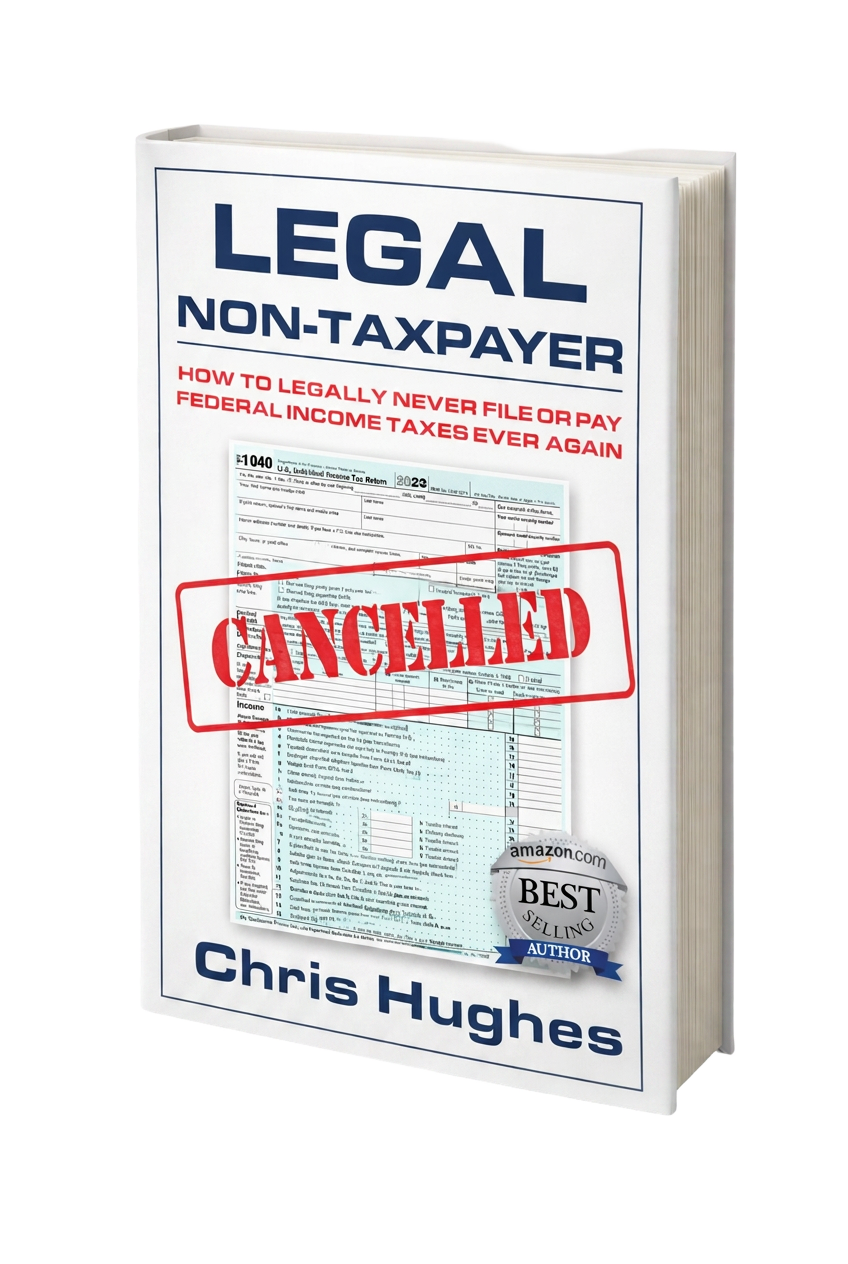
Start where everyone starts — the book.
Free, and cited to the primary sources so you can verify every claim yourself.
Instant download, sent to your email.


Profile
Chris's story
Chris spent years studying the primary sources: the United States Constitution, decisions of the United States Supreme Court, the original 1913 tax code, and its modern form, the Internal Revenue Code. He went on to write the only book ever published specifically on the Revocation of Election process.
Those are the only sources cited throughout his book. God excluded, there is no higher authority than the Constitution, the law as enacted by Congress, and the decisions of the United States Supreme Court.
The IRS is not a higher authority. Tax attorneys are not a higher authority. And certainly, ChatGPT, Grok, or any other artificial intelligence platform is not a higher authority.
On numerous occasions, publicly and via certified letters, he has challenged—even dared—the Internal Revenue Service and the United States Treasury to deny the Revocation of Election process or directly refute the law as written in 26 U.S.C. § 6013(g)(4)(A).
They have not done so. They won't do it. They can't. It's the law.
Since the establishment of the modern Internal Revenue Service, the agency has never published a specific derogatory statement regarding the Revocation of Election process or directly disputed the statutory provision upon which it is based. That becomes even more significant when you examine the IRS's own publications.
The IRS publishes an extensive document entitled The Truth About Frivolous Tax Arguments, addressing dozens of arguments taxpayers have advanced in an effort to challenge or avoid federal income-tax filing and payment obligations. Yet throughout that publication, you will not find a discussion of the Revocation of Election under 26 U.S.C. § 6013(g)(4)(A).
Not once.
Since the establishment of the modern IRS in the 1950's, the agency has never issued even one derogatory statement regarding the Revocation of Election process or directly disputed the statutory language found in 26 U.S.C. § 6013(g)(4)(A).
In 2022, the IRS published a 66-page document entitled The Truth About Frivolous Tax Arguments. The publication is devoted to identifying and responding to arguments taxpayers have advanced in an effort to avoid what the IRS considers their legal obligation to file and pay federal income tax.
Yet throughout all 66 pages, there is not a single reference to the Revocation of Election process or to 26 U.S.C. § 6013(g)(4)(A).
The IRS had every opportunity to identify the Revocation of Election as frivolous, challenge the statutory provision, or explain why it believes the process is invalid. It did not.
They won't. They can't. It's the law.
It is discoveries such as these—combined with Chris's intense research, attention to the deceptive language of the law, and a fearless willingness to challenge conventional thinking—that have established him as a leading thought leader in the tax-freedom movement and the foremost authority in the Revocation of Election industry.
His approach is simple: "Don't take my word for it—or anyone else's, for that matter. Go directly to the source. Read the law. Study the controlling authorities. It's all laid out in my free book. Then decide for yourself."
“Don't believe me. Read the law for yourself.”Get Chris's free book
As featured
FOX — Chris Hughes on why thousands of Americans are revoking their election.
Client Reviews
Five stars, in their own words
Real clients of Freedom Law Group. Names shortened for privacy; wording unedited.